A truck laden with nearly 300 Indane LPG cylinders caught fire and exploded on NH58 in Khankra between Rishikesh and Badrinath on 23/6/2017 morning, according to ANI report.
The Chardham Yatra has been partially affected by the untoward incident.
Sunday, 25 June 2017
LPG laden truck catches fire on NH58 in Uttarakhand on 23/6/2017

Tuesday, 13 June 2017
Royal Enfield Bullet rider fined for not wearing seatbelt in Goa in June 2017

It is obvious that bikes don’t offer a seatbelt and that the officer meant to write helmet. However, this challan is certainly funny to read. The scanned copy of the challan has gone viral over the internet over the past few days. Luckily though, the officer got the Section of Law right. While the offense for not wearing a seatbelt comes under Section 177 of the CMVR, that of not wearing a helmet comes under Section 129 of the Motor Vehicle Act.
It is quite common to see people not wearing helmets, carrying more than one pillion and even jumping signals when on the bike. It is only in India that we see people not really taking such rules seriously. Everywhere else, people wear helmets and riding gear to protect themselves, not just to be safe from getting fined.
A lot of riders sling the helmet on the handle bar and wear it while nearing a cop. Make sure to buy a helmet that has a ISI mark. Also, wearing other riding gear such as gloves, knee guards and jackets can help save riders from injuries during an accident.
Wednesday, 7 June 2017
Salt laden truck falls on Maruti Swift leaving 5 passengers dead in Jaipur
A salt laden overloaded truck fell over a car in the wee hours of Tuesday, 2017-06-06. The accident happened at the Chomu Circle area near Jaipur, Rajasthan.

The 18-wheel truck that weighed about 46 tonne overturned while taking a turn. The Maruti Swift car was parallel to the truck when the incident happened. The truck was carrying sacks of salt which completely covered the Swift.
Local police say that the car remained under the truck for nearly three hours. No one knew about the car till a crane came and lifted the truck from the spot. The accident took place at 4 AM, but the flattened Swift was discovered only at 6 AM. By then, all the passengers were dead.
“At first, we thought it was a simple case of an overloaded truck turning turtle due to a sharp turn, however, when we lifted the truck, we found a car buried under it. The car was completely flattened and the bodies disfigured. It was an arduous task for us to remove the bodies from the car as they were badly trapped,” a police official who was present at the spot told TOI.
There were 5 occupants in the vehicle and all of them were badly disfigured. The family was preparing for a wedding. The engaged couple along with 3 others were on their way to Nahargarh Fort when the accident took place. They had planned to see the sunrise from the fort, which is situated at the top of a hill.

The driver and the helper of the truck fled the spot immediately after the mishap. The cops suspect that the truck was being driven at a high speed and the driver suddenly applied brakes that caused the heavy vehicle to lose balance and turned turtle. The Swift has been transformed into a sheet of metal.
Indian roads are full of overloaded vehicles which pose a great threat to everyone around. It is extremely important to be extra cautious from these slow moving vehicles on the highways. Here are a few things that one can do to avoid such mishaps.
Never drive near overloaded vehicles or goods vehicle, they move slow and are potentially dangerous. While overtaking, do not spend too much time alongside such heavy vehicles, overtake quickly and promptly. If a big vehicle is following your car, give way or drive away from it. Such vehicles have low braking power and can rear-end your vehicle. Never overtake a heavy vehicle on sharp turns and corners. They are prone to tilting on its sides while taking sharp turns.
Source: Times of India, Hindustan Times, CarTorq.com


Sunday, 4 June 2017
Ambulance Bike in India

The rural roads of India are extremely narrow. After a few ambulances failed to reach interior parts of rural areas, innovators came up with unique bike ambulances. The bike ambulance consists of a sidecar that has been modified for the patient to lie down and travel. This jugaad is truly a life saving one.
Source: CarToq
Wednesday, 31 May 2017
Pune - Hampi - Pune bike ride in 4 days in mid-May 2017
Two expatriate students studying in Pune rode to Hampi and back in their Bajaj Pulsar 180 motorcycles in May 2017.
Day 1:
They crossed Magarpatta (Pune) at 5.30 am.
Route: Pune - Indapur - Solapur - Bijapur - Hungund - Hospet - Hampi.
Pune to Solapur is superb 4-laned NH65 (erstwhile, NH9) which they did non-stop in 3 hrs 15 mins.
Crossing through Solapur town during the morning rush hour took about 25 mins including a brief stopover for tea and breakfast at a roadside stall. There isn't any bypass to avoid the mess in Solapur.
Solapur to Bijapur had a high volume of unruly local trucks and two-wheeler traffic. It's still a 2-lane stretch throughout.
Bijapur to Hospet was a comfortable ride on very well maintained 4-laned roads. Hospet to Hampi is only a distance of 13 kms.
Since they had an early morning start from Pune, they could check-in to their hotel (no prior bookings) around 6.00 pm.
Day 2 and 3:
They explored the ruins of Hampi.
Day 4:
The return ride was through the same route as the onward journey. The timings were almost the same as that clocked while riding from Pune to Hampi.
Thursday, 25 May 2017
Affordable Ford Electric SUV Targets 500 Km Drive Range
Ford electric SUV will compete against Tesla Model Y with targeted electric range of above 500 km. It's expected to be an affordable vehicle.
Ford has set its hopes high just like every other global auto brand in terms of commercializing the all-electric mobility solutions. As part of it, the Blue Oval has targeted zero emission based long range EV which is likely to compete against the likes of Tesla’s Model Y.
The first piece in the puzzle has been spilled now as some details have emerged recently. In a conversation with Yahoo, Ford’s Chief Technology Officer Raj Nair has stated that the full-electric crossover will be for the masses as it will be an affordable model. Moreover, it is confirmed to have high level of electric driving range. He reckons Ford has the technology path responsible for getting to a mileage of more than 300 miles (could be above 500 km) while being competitive and affordable.
Ford seems to be aiming at launching this all-new affordable SUV when Tesla arrives with the Model Y. The latter is essentially a baby Model X and sits right on the entry-level slab of the electric vehicle maker. Elon Musk has not officially revealed any information about the Model Y but it is said to be based on a new flexible platform that could underpin further products along the line in the future. With Ford having set its eyes on above 500 km range on a single charge, Tesla could be focussing on doing the extra miles. It certainly has the head start by being a full-fledged EV manufacturer already and has invested heavily already on the future products. Ford’s Nair says the competition is welcomed and more the penetration better will the economies of scale be.
In addition to the development of the electric crossover, Ford is also investing $4.5 billion into exploring the uncharted territory of electrified mobility. A hybrid Mustang is tipped to be introduced by the end of this decade while the F-150 truck and the Transit van are also in the pipeline to get electric versions according to several reports.
Source: Yahoo
Curated from: Gaadiwaadi.com in May 2017.
Napier Museum, Thiruvananthapuram in Kerala, India

The 19th-century design of Thiruvananthapuram’s Napier Museum is an amalgam of Kerala, Chinese, Italian, and Mughal architecture.
(Photo Credit: TSCreationz/Shutterstock)
Summers can be ‘hot as Hades’ in Thiruvananthapuram in God’s Own Country, except in one place in the city—the Napier Museum with its natural air conditioning. Right then, though, standing in the middle of this landmark building in the city, I could hear my friend’s voice in my head: “Don’t forget to look up at the ceiling,” he had said.
When you think of overwhelming ceilings, you think of the Sistine Chapel or the Blue Mosque in Istanbul or the Sensoji Temple in Tokyo. Museums usually do not feature on the list. The only deviation is the National Gallery of Victoria in Melbourne: its 200-foot-long ceiling is made of 10,000 pieces of hand-cut glass in 50 different colours. At Napier, I find myself with my mouth agape at hand-painted frescoes on the coffered ceiling of one of the oldest museums in the country.
Situated inside a garden spread over 55 acres, the Napier Museum was established in 1857, and in 1880 the old building was demolished and a new structure built by Ayilyam Thirunal Maharaja of Travancore. It was designed by the English architect Robert Chisholm who was sent to ‘Trevendrum’ by Lord Napier, the Governor General of the then Madras Presidency.
Chisholm conceived a museum based on the local architectural style. However, Kerala’s native architecture has for long been influenced by the cultures of its trading partners—Chinese, Japanese, Arabs, Europeans and so on. Hence Chisholm’s ‘native design’ was, in fact, a combination of Kerala, Chinese, Italian, and Mughal architecture. It can be seen in the Gothic roof, minarets, hand-painted frescoes and extensive ornamentation of the museum.

Napier Museum Thiruvananthapuram
Napier museum’s facade features many interesting minute details like oriel windows that are supported by carved wooden horse corbels.
(Photo by Sudha Pillai)
This dreamy, romantic, and fusionistic style is known as Indo-Saracenic (Saracenic is derived from the word Saracen, an archaic name for Muslims given by the British). Also known as Indo-Gothic, it was the style of architecture used by British architects in late 19th century India. It drew elements from native Indian architecture and combined it with the Gothic revival style favoured in Victorian Britain. But even with so many styles and influences in play, Napier Museum did not end up a mish-mash of a museum. Only to the destitute of vision, the museum might be a garish amalgamation.
Aeons ago, a visitor told a curator of the Napier Museum: “I suggest you remove all the artefacts from this building. Because the building itself is an elegant object d’art and should be viewed singularly without any distractions.” I concur. For the next couple of hours, the rare artefacts, idols, carvings, coins, and paintings in the museum became invisible to me. Craning my neck upwards, I walk around the museum to discover art and history in nooks and corners, arches, balconies, and ceilings. It was like finding forgotten ancestral treasures in the attic. Riches wrapped in fables and fantasies, waiting to reveal themselves to those who come looking.
The museum has three massive halls connected by long corridors. The walls are striped—in pink, blue, yellow, and cherry red. They augment the scalloped arches in banana yellow colour with red, white and pink latticework. It is a cornucopia of colours; as exciting and eye-popping as a chilled glass of falooda on a hot summer afternoon. Wide balconies flank the central hall at both ends, and they are supported by wooden corbels that have intricately carved yalis or dragons. Stained-glass windows stipple the walls throwing up magnificent play of light. The ledge above the doors carries the statues and carved figurines of goddesses. Floral motifs embellish the friezes on the walls. These are interspersed with the design of Valmpuri shankhu or the conch shell of Lord Vishnu—the deity of the royal family of Travancore and also the royal insignia.
By now, there should be a crick in my neck. But I don’t feel it as I get caught up in all the action above. The museum’s vaulted ceiling has hand-painted panels, beams, and cross-beams in teakwood with muted gold-coloured inlays that sparkle in the light. Oriental frescoes of flowers and leaves in yellow, red, green and earthy colours contrast the wooden braggers of dragons supporting the painted beams. The colours on the frescoes seem to change with the light of the day. The frescoes, which have been painted using natural vegetable dyes have withstood the test of time and remain, one of the chief attractions of the museum.

Napier Museum Thiruvananthapuram
Inside the museum, the historical artefacts battle for attention with the vaulted ceiling adorned with handpainted frescoes.
(Photo by Sudha Pillai)
I wind my way up the dusty, neglected narrow stairway to the top of one of the four watchtowers. At the end of it is a breathtaking aerial view of the museum and the city beyond. The roof resembles a well-constructed abstract work or an exciting board game. A closer look reveals the ornamental stone projections of the gable roof. It is truly an artisan’s labour of love.
Otherwise, how does one explain the decorated railing or cresting along the ridge of the roof where it is bound to go unnoticed and unappreciated? From this vantage point, I could see the extensively decorated pediments of the gable roof. There are also bargeboards or decorative woodwork on the rafters projecting from the roof. The soffits are in terracotta, stone, and wood. The building is dotted with oriel windows, supported by richly carved corbels and tassels in the form of mythical horses. This is a characteristic feature often seen in Victorian and Arab (mashrabiyya) architecture.
It is blazing hot outside, but I am yet to break a sweat while walking up and down inside the museum. The famed natural air cooling of Napier Museum is at work. The museum has double walls with ventilators, which trap the hot air, tempering it before allowing it to flow into the museum, providing a cooling effect without any modern air conditioners. Understan-dably, footfalls to the museum increase during the summer season, I am told.
The Napier Museum with its Gothic structure, high arches, intricately carved balustrades, hand-painted frescos and stone ornamentations stands testimony to a cultural sharing from aeons ago. I have always wondered why some of the most famous artworks in the world were high up on the ceilings of monumental structures. What was the purpose? I discovered that the act of looking up could lead to an uplifting experience. I am glad I listened to my friend and “looked up”.
The Napier Museum is on L.M.S Vellayambalam Road in Thiruvananthapuram’s Kanaka Nagar. It is 3 km away from the Thiruvananthapuram Central Railway Station and 9 km from the airport.
Open Tuesday, Thursday, Friday, Saturday, Sunday 10 a.m. to 5 p.m.; Wednesdays 1 p.m. to 5 p.m.; closed on Mondays.
Content & photo credit: Ms.Sudha Pillai, Natgeotraveller.in
Saturday, 20 May 2017
Kummatti festival at Kunissery in Palakkad district, Kerala, India

Kummatti is a festival of colour, fun and light at Pookulangara Bhagawathy Temple in the small, quaint and simple village of #Kunissery, #Palakkad district, #Kerala, #India.
Elephants’ parade with percussion music, art forms.
Coordinates: 10°38′20″N, 76°35′35″E
Festivals in Kerala are held according to the Malayalam calendar. In 2017, the Kummatti festival was held on 25th March.
The closest town from Kunissery is Alathur on NH544 and is about 7 km away.
Kochi to Palakkad via NH544 (i.e. via Aluva, Angamaly, Chalakady, Pudukad, Alathur, Kuzhalmannam) = 145 kms and takes about 3 hrs 30 mins by car.
Alathur to Palakkad via NH544 (i.e. via Kuzhalmannam) = 27 kms (30 mins).

Friday, 12 May 2017
Udaipur to Chandigarh - Best Route For Road Trip, Indian Roadie Preferred Route, Motoring Route, Driving Route
Best Route For Road Trip, Indian Roadie Preferred Route, Motoring Route, Driving Route from
Udaipur to Chandigarh (Union Territory and capital of Punjab, Haryana)
(Udaipur_Chandigarh):
Option 1:
Udaipur - Ajmer - Jaipur - Rewari - Jhajjar - Rohtak - Panipat - Karnal - Ambala - Chandigarh
Option 2:
Udaipur - Ajmer - Jaipur - Shahjahanpur - Narnaul - Charkhi Dadri - Bhiwani - Jind - Panipat - Karnal - Ambala - Chandigarh
Indian Roadie does not encourage planned night driving.
Note: These are user generated best routes.
Abbreviations in use in Motoring Routes Of India, Indian Roadie Preferred Route, Motoring Route, Driving Route:
RA = Road Ahead.
ROR = Road on Right.
ROL = Road on Left.
NH = National Highway.
SH = State Highway.
NE = National Expressway.
ROR = Road on Right.
ROL = Road on Left.
NH = National Highway.
SH = State Highway.
NE = National Expressway.
P.S:
- Offline Driving Route In One Page
- Skip Online Navigation Maps
- Skip Google Maps
- User Generated Best Routes
.
.
.
.
.
* Motoring Routes Of India, Best Route For Road Trip are initiatives by Indian Roadie (India's most admired road travel and automotive forum for matured roadies) and Marketingpundit.
P.S: Search thousands of accurate and best route options for road trips throughout India, Nepal, Bhutan in:
Monday, 8 May 2017
Car skids on oil spill and hits bus in Kamshet Tunnel on Mumbai-Pune Expressway, 5 dies
Four members of a family and a driver from Virar died after the car they were travelling in skid on an oil spill inside Kamshet tunnel on the Mumbai-Pune Expressway and rammed a parked luxury bus. Three others were injured in the accident that took place on Sunday 2017-05-07 afternoon.
The deceased were identified as Dattatray Deshmukh (63), his wife Bhagini (60), daughter Rakhee Patil (38), granddaughter Shraddha Patil (19) and car driver Deepak Waghashe. The injured - Dattatray's son Rupesh (34), grandson Om Deshmukh (2) and granddaughter Sanjana Patil (15) - have been admitted to Lokmanya Hospital in Nigdi, Pune. Their condi tion is critical, said Kamshet police sub-inspector Bhosale.The Deshmukhs and Patils were returning home when their car met with an accident.
According to the police, the driver of the luxury bus, which was plying from Pune to Mumbai, noticed a fire in the fuel tank as the vehicle entered the tunnel. He pulled over to the ex treme left inside the tunnel and rushed out to douse the fire. But as a lot of fuel had already spilled on to the road, the Honda Mobilio that was coming from behind the bus at high speed, skid. The driver lost control of the vehicle and it spun and crashed into the bus, said a police officer. Waghashe died on the spot.
“The highway patrol police and IRB rescue team rushed to the spot with an ambulance. All injured passengers were taken to hospital, but four of them were declared brought dead. The three others are in critical condition,“ said Bhosale. “Traffic movement was disrupted for an hour as other motorists slowed down inside the tunnel to look at the mangled car.“
This was the second time in the day that traffic came to a standstill on the same stretch.Around 8.30am, a speeding eggladen truck rammed into a crane near Kamshet tunnel and fell on its side. As the highway patrol police halted traffic on one lane on the Mumbai corridor to wash away the smashed eggs that had made the road slippery , vehicles lined up.
Source: May 08 2017, The Times of India (Mumbai)
Wednesday, 3 May 2017
Bengal trails - Pandua, Hooghly district


Photos from a day's drive to Pandua, Hooghly district, West Bengal.
Fernhill Palace, Ooty, India


The first Fernhills bungalow was built in 1844 by Capt. F. Cotton. It changed hands over a period of time till mid-1860 when it was temporarily named Moonesami and served as one of Ooty's earliest country club. During the time of the British Raj, the English elite would flee the hot and muggy plains of the Madras Presidency and take sanctuary in the refreshing cool climes of Ooty, with its expanses of undulating hills and terraced tea gardens.
Fernhill Palace was the erstwhile summer residence of the Maharaja of Mysore. The palace resembles a Swiss Chalet. Its carved wooden bargeboards and ornamental cast iron give it that characteristic appearance. The palace grounds accentuate the alpine look of the place with its manicured gardens, firs and cedars. There is an interesting church like indoor badminton court on the grounds.
The Palace is spread out over 50 acres (200,000 m2) of green lawns, stylized gardens and dense woods with spectacular views of terraced tea gardens and lush verdant valleys.
Presently its a luxury hotel in Ooty named WelcomHeritage Fernhills Royale Palace.
Friday, 28 April 2017
Coorg women are gifted wine makers
Coorg women are gifted wine makers. It is said, “Gift a Coorg woman a bouquet of roses, she will thank you politely and as soon as you are out of sight, she will rip off the fragrant petals and turn it into wine”. So you see Coorg women can transform anything and everything into wine that catches their fancy. Cashews, rose petals, rice, raisins, plums, berries, passion fruit and even hibiscus. Unbelievable, right?
Variants also include "Pomegranate", "Beetal Leaf", "Ginger", "Sapota" wines. There's a lady in Coorg who also makes the world's best home made "Apricot Brandy". Female guests at family functions love all these flavors without the worry of getting drunk!!
Homemade wines are sugary, full of flavour and fragrance. Passion fruits form the ingredient of their wine making as these trees with juicy and rich flavoured fruits grow galore along the hills of Coorg, Karnataka, India.
P.S: Content curated from Cheers Coorg.

Saturday, 15 April 2017
A day's drive to Kotilingeshwara Temple, Kolar, Karnataka which boasts of the tallest Shivalinga in Asia
The Kotilingeshwara Temple lies in a very small village named Kammasandra in the Kolar district. The temple is extremely famous because of the largest and the tallest Shivalinga present in Asia. More than 2 lac devotees visit this temple every year.
Maha Shivaratri is a special occasion and a large number of devotees make it a point to be there on this auspicious day. The temple can be easily reached from the gold fields of Kolar.

Kotilingeshwara. Image courtesy Mithila

The Shivalinga is 33 mts tall. It has an accompanying Basava statue which is 11 mts tall and is surrounded by a large number of Shivalingas spread across the area. The project involves an establishment of one crore shivalingas hence it is named Kotilingeshwara and currently, there are about a hundred lakh shivalingas.

Kotilingeshwara Temple. Image courtesy pponnada

Quick Facts about Kotilingeshwara Temple, Kolar
The best time to visit: between July and January.Address: Kodilingam Temple Road, Ghattakamadenahalli, Kolar-563121 (Map)Timings: 6:00 AM- 9:00PMEntry Fee: INR 20 per personCamera Fee: INR 100 per cameraParking Charges: INR 30Linga Installation Fee: Starts from INR 6,000

Panoramic View of Kotilingeshwara Temple. Image courtesy Visurao4all

History of Kotilingeshwara Temple, Kolar
This temple has been constructed by Swami Sambha Shiva Murthy in the year 1980. The first linga was installed in 1980 and since then there have been many lingas present in the temple. There is also a huge and tall Nandi installed beside the linga. The Nandi is 11 mt tall and sits over a huge platform.
Within the premises of the temple, there are about eleven other temples for different deities. The first of them includes the temple of Lord Vishnu, Lord Brahma, and Lord Maheshwara temples. This is followed by a temple of Lord Kotilingeshwara.

Kotilingeshwara Temple. Image courtesy Pponnada

The temples include Goddess Annapoorneshwari Temple, Goddess Karumaari Amma Temple, Lord Venkataramani Swamy Temple, Lord Panduranga Swamy Temple, Lord Rama, Sita and Lakshmana Temple, Lord Panchamukha Ganapathy Temple, Lord Anjaneya Temple, and finally Goddess Kannika Parameshwari Temple.
The Government has declared this temple as a tourist spot so that hundreds of tourists from across the World can come and pay their respects to the largest Linga in Asia. Two flower trees, named one Nagalinga and Cannon Ball are located here, and many unmarried women pray for a blessed and happy married life.

Kotilingeshwara Temple. Image courtesy Pponnada

Poojas at Kotilingeshwara Temple, Kolar
Daily poojas are performed at all the installed Shivalingas by the priests every day. The pooja is carried out with music and drums and all the priests recite mantras as well as pour water on the lingas.
The devotees can also offer special poojas by installing the lingas. These lingas can be installed on any day chosen by the devotees in their names. Regular poojas will be carried out and offered to all the lingas installed.

Kotilingeshwara Temple. Image courtesy Pponnada

Facilities at Kotilingeshwara Temple, Kolar
There are rest houses constructed for devotees in the temple premises. In addition, free mass marriages are performed here every year. This is carried out by priests with drums, music and chants. Currently, there are around twenty weddings performed every week. There is also a meditation hall built for devotees who wish to meditate in peace.

Kotilingeshwara Temple. Image courtesy Mithila

How to Reach Kotilingeshwara Temple, Kolar
By Road
If you want to reach the temple by road, you need to head through Kolar. Kolar is at a distance of 2.5 hours from Bangalore. Kotilingeshwara Temple is a day's drive from Bangalore and back.
Harley-Davidson from Mumbai meets a ship of the desert in near Kumbhalgarh Fort, Rajasthan, India

It was near Kumbhalgarh Fort in Rajasthan, India where a Harley-Davidson from Mumbai, almost 1200 kms away crossed paths with a ship of the desert, viz. camel.
India is one country where one gets to see a $160K LandRover Evoque sharing a highway with a $40K Harley or Indian and with camel carts strolling past at easy pace. It's a country of mixed demographic profile. Come to India. Do a 'backpacking India on road' and also 'be my car travel buddy in India'.
Photo courtesy: Bharat De.
Friday, 14 April 2017
PanchaMukha (five-faced) Hanuman Temple is 2 kms from Rameshwaram temple in Tamilnadu, India


PanchaMukha (five-faced) Hanuman Temple is 2 kms from Rameshwaram temple in the state of Tamilnadu, India.
Here Hanuman is dressed with vermilion. The temple also has deities of Rama, Sita and Hanuman which were originally at Dhanushkodi but were brought to the temple site after the killer cyclone in 1964. A few of the floating stones called 'Sethu Bandanam' supposedly used for building the ancient bridge between India and Sri Lanka are carefully preserved in the temple.
By worshipping PanchaMukha Anjaneyar, one can get rid of enemies with the help of Narashima Mukha, overcome all types of Dosha with the help of Garuda, get all types of wealth with Varaha; and get Gnana with Hayagriva.
At this temple, there is an oil-fired lamp next to lord Ram which has been kept burning for over three decades. Panchamuga Anjaneyar’s huge idol is open to the sky without any canopy on top. It is believed that the 700 years old temple at Dhanushkodi, was also destroyed during the cyclone in 1964 and some of the 'moorthams' (idols) were brought here.
Temple timings: 6:00 AM to 12:00 Noon, 4:00 PM to 9:00 PM
Sunday, 2 April 2017
Assam's 126-km long twin bridges will be India's largest
The longest bridge in the country will come up in Assam soon. Twin bridges running along 126 kilometres will stretch from Sivasagar in Upper Assam, connecting the river island Majuli to the rest of the state.
“The project, running up to Rs 15,000 crores, has been sanctioned by the Centre. A South Korean company is working on a detailed project report (DPR) which will take a year to complete,” Assam Chief Minister Sarbananda Sonowal told DNA.
The bridges, Sonowal said, will start at the Nitai Pukhuri bridge in Sivasagar, pass via the Tekeli Phuta bridge in Dhakuakhana, from where the bridge will trifurcate and connect Majuli island at the ports at Kamalabari and at Nemati.
Majuli, the biggest river island in the world, was earlier part of the Jorhat district, and is Sonowal’s constituency. He had promised to declare Majuli a district and build a bridge to connect it to the mainland. Majuli has now been declared a district.
Sonowal also said the state is also working on the island’s problem of erosion. “We are working on a project to dredge the riverbed so that it can hold more water. This will allow for the passage for ships of up to 10,000 metric tonnes via the river,” he added.
The CM said that the sand that will be deposited on both sides of the river will be converted into national highways to stop the erosion. Sonowal added that the idea was mooted by the Union Minister for Road Transport and Highways and Shipping Nitin Gadkari.
Waterways as a mode of transport has been largely ignored, he said. “The British used the Brahmaputra to transport Digboi’s oil, Margherita’s coal and Tinsukia and Dibrugarh’s tea, on to Bangladesh via the Padma, and then on to other parts of the world to develop a global trade environment. The river is the cheapest mode of travel. If rail transport costs you a rupee and road transport Rs 1.5, river transport costs only 30 paise,” said Sonowal.
Source: DNA, New Delhi dated 2017-04-01.
Sunday, 26 March 2017
HOGs at Asansol Energy (IOC) on 2017-03-26 evening
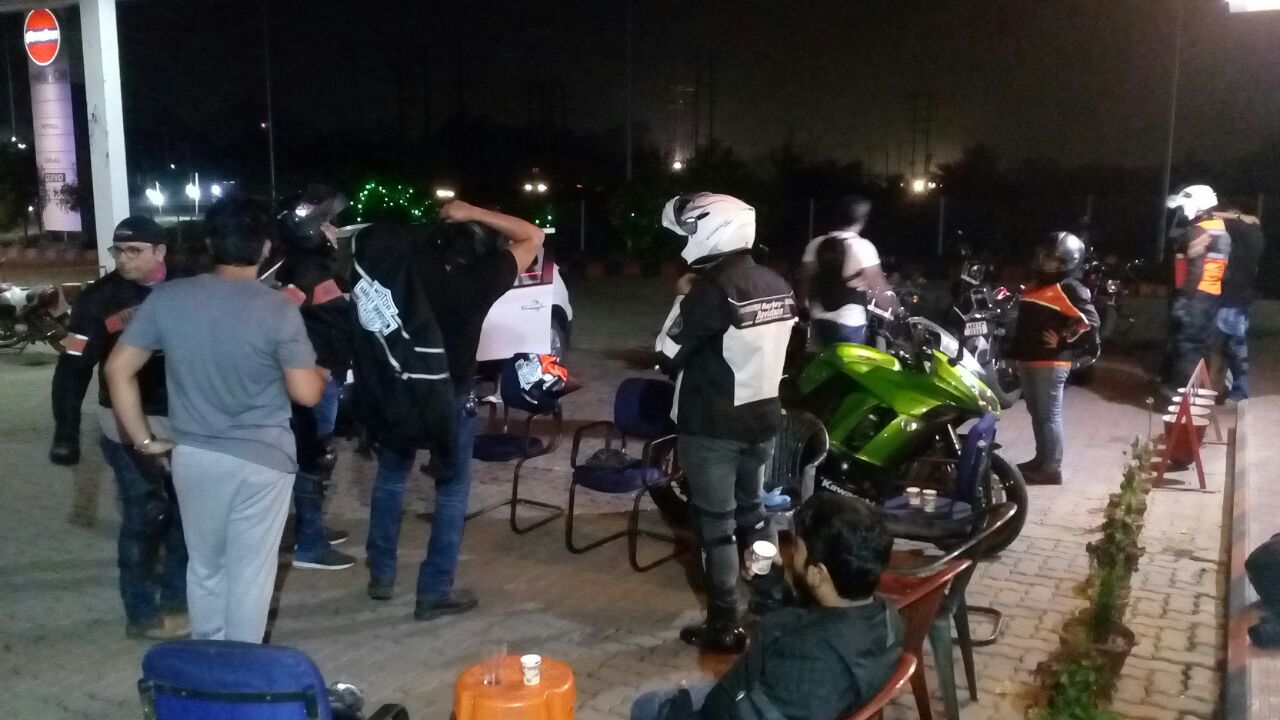


HOGs on their return ride from Adra to Kolkata stopped to tank-up at Asansol Energy (IOC), on NH2 between Ghagarburi Temple and Kalipahari on 2017-03-26 evening.
There was an Indian and a Suzuki 1000 in the group, too. The others were Fatboy, Fatbob, Street, all from the Harley Davidson stable.
Sandip Samanta (owner of Asansol Energy), an avid Indian Roadie fan treated the 16 riders to hot 'pakoras' and tea.
Incidentally, #AsansolEnergy is an #IndianRoadiePreferredFillingStation.
HOG => Harley Owners Group.
Let's explore India together on road

I am at Barnawapara Wildlife Sanctuary, the land of leopards in the state of Chattisgarh, India while driving solo from Pune to Kolkata.
I love to see India while travelling together with wanderlust backpacking travellers from throughout the world. 3 to 4 persons at a time from across the world are invited to travel with me in my car (SUV or sedan) at a very low cost (we will go Dutch!) in total comfort and absolute safety.
In the process, my travelbuddies get a true feel of entire India, its culture, topography, people, food, etc, etc. I get them to talk to the local populace in villages/ towns/ cities, school students, and also engineering/ business school students at various locations to understand the true India.
Multiple numbers of driving circuits have been planned for all weather round the year drives. However, we strictly do not drive during the night.
For students, researchers, bloggers, photographers, friends, couples, backpackers this will be one cherished and unforgettable holiday. This is not a business proposition. We simply embark on a journey and drive around as friends!
Does this sound interesting? Do you have friends who could be interested in joining me?
Email me on: roadieglobal@gmail.com
Call/ WhatsApp: +91 82408 49300
Connect to me and 'inbox' me on: www.facebook.com/deepbanerjee.marketingpundit.
Also 'like'/ 'join' the Facebook 'pages'/ 'groups' @ IndianRoadie, @ GlobalRoadie.
Follow me on Twitter @IndianRoadie, @GlobalRoadie.
#BeMyCarTravelBuddyInIndia
#BackpackingIndiaOnRoad
Drive to Tungnath, world's highest Shiva temple
Tungnath (12051 ft above sea level) is the world's highest Shiva temple.
One can reach Chopta from Haridwar or Rishikesh. It's approx 163 km from Rishikesh. One can drive or can take a bus or taxi till Chopta.
From Chopta it's a trek of 4 - 5 kms for Tungnath.
Photo credit: Dinesh Negi

Subscribe to:
Posts (Atom)